
In 2026, BIM is no longer an experimental technology or niche workflow. It is a strategic backbone of how leading architecture, engineering, and construction (AEC) firms win work, manage complexity, and deliver on time and on budget.
According to reports, the global Building Information Modeling (BIM) Market was valued at USD 5.58 billion in 2025 and is expected to get USD 6.45 billion in 2026, USD 7.45 billion in 2027, and USD 20.56 billion in 2035. Its growth rate would be 15.6% over the forecast period, which is mainly attributed to cloud collaboration, AI integration, and 3D/4D/5D modeling technologies.
The correct BIM stack has the power to reshape workflows, which we have experienced over the decade. But as capabilities expand, decision makers face harder choices. This guide cuts through the noise, helping you align software selection with real business value, helping in reduced risk, improved coordination, lower costs, and faster delivery.
Why BIM Software Selection Matters More Than Ever in 2026
It has been a long road for the construction industry on this BIM journey, and its transformation is evident. In 2015, BIM usage was rather limited to a tool that set the company apart in the market. In 2026, BIM will be an integral part of the design process and sometimes even compulsory.
The decision-makers have to deal with the following problems:
- The project's complexity is increasing faster than the number of workers
- Different teams working from different places need to be in constant communication.
- Clients are requesting advanced BIM outputs and not just models.
Market statistics are in favor of this move. BIM is now used by more than 60% of the large companies in the construction business, with 55% of them applying the workflows of clash detection. The usage of cloud collaboration has increased and become standard practice more than an exception.
In one of the cases, we collaborated with a contractor from the Fortune 500 list in 2024. He was convinced at first that BIM was just a tool for design. By 2025, he had included 3D BIM models in construction planning and sequencing. As a result, the onsite clashes were reduced by almost 40% and the rework costs by 15 to 20%. This was not a one-off situation. Such outcomes have been
backed up by the research of the industry which indicates that with the adoption of mature BIM there is a significant decrease in design errors and rework.
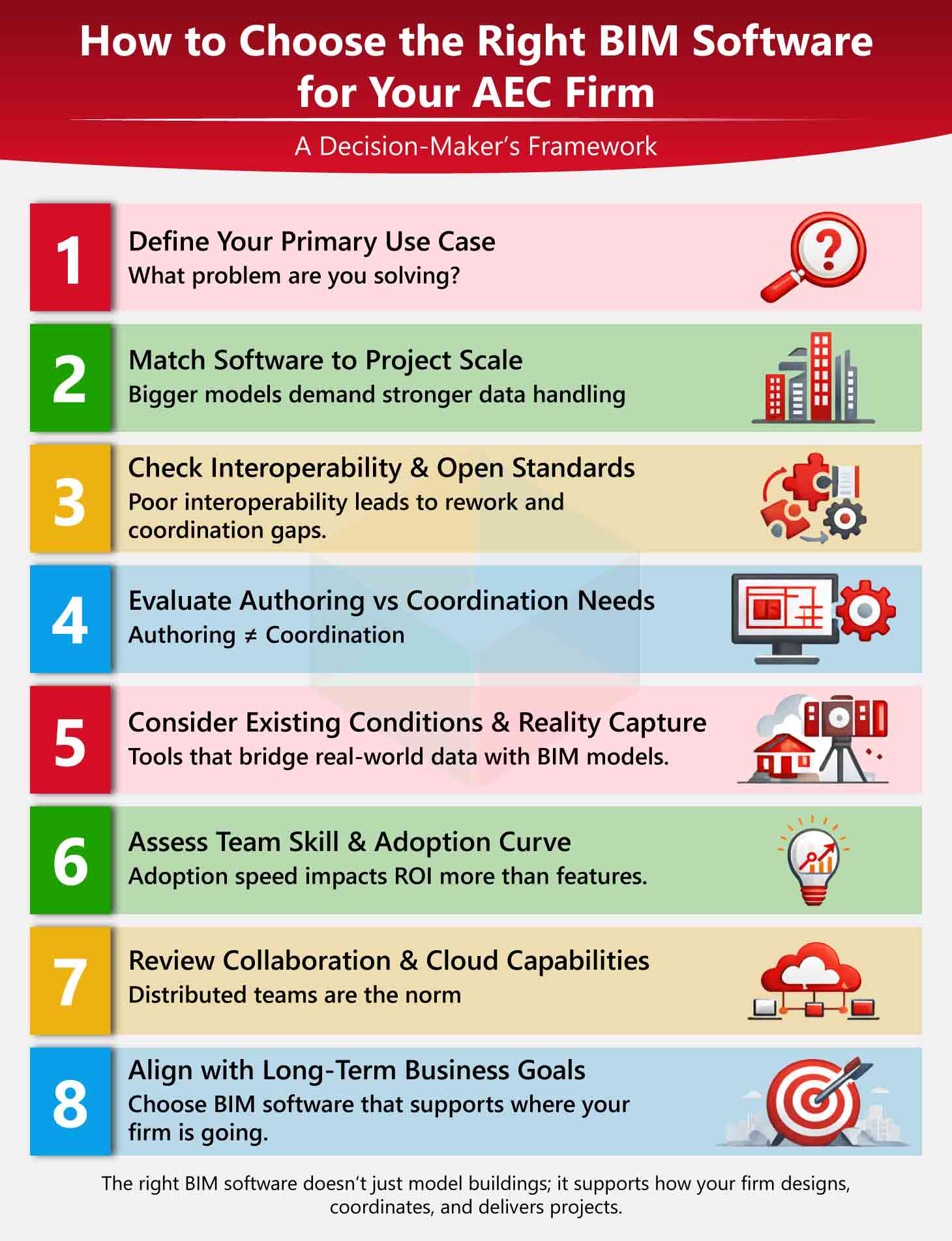
In 2026, your choices for BIM construction software should be strategic and not haphazard. This entails synchronizing tools with workflow value rather than trends.
What AEC Decision Makers Consider While Choosing the Best BIM Software
Before diving into the software profiling, let us first consider the way the savvy decision makers do the assessments.
Project Type Alignment
- Large mixed-use developments against linear infrastructure
- Architectural creativity opposed to heavy fabrication needs
Collaboration & Integration
- Is the platform compatible with IFC and open standards?
- Cloud compatibility for multi-office and multi-discipline workflows.
Learning Curve & Adoption
- The difficulty of onboarding compared to the depth of technical power
- The existence of training and certified partners.
Scalability
- Is it possible to manage the mega-project datasets?
- The performance on MEP, structure, and site models.
Total Cost of Ownership
- The cost of software subscriptions
- Implementation, training, and support costs
A decision maker would choose BIM authoring software that can cut risks, raise profits, and grow along with the company’s aspirations.
BIM Software Comparison by Use Case
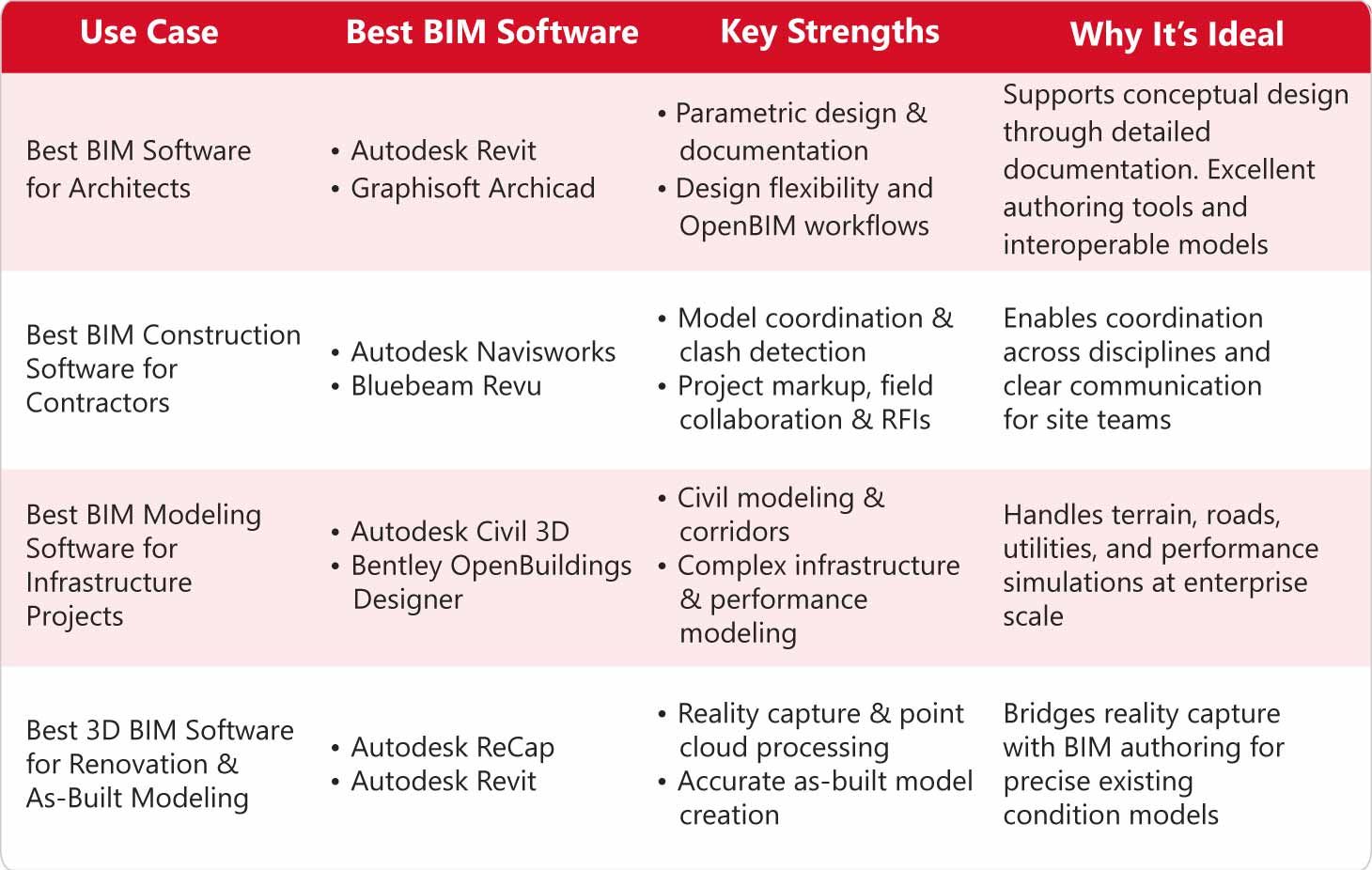
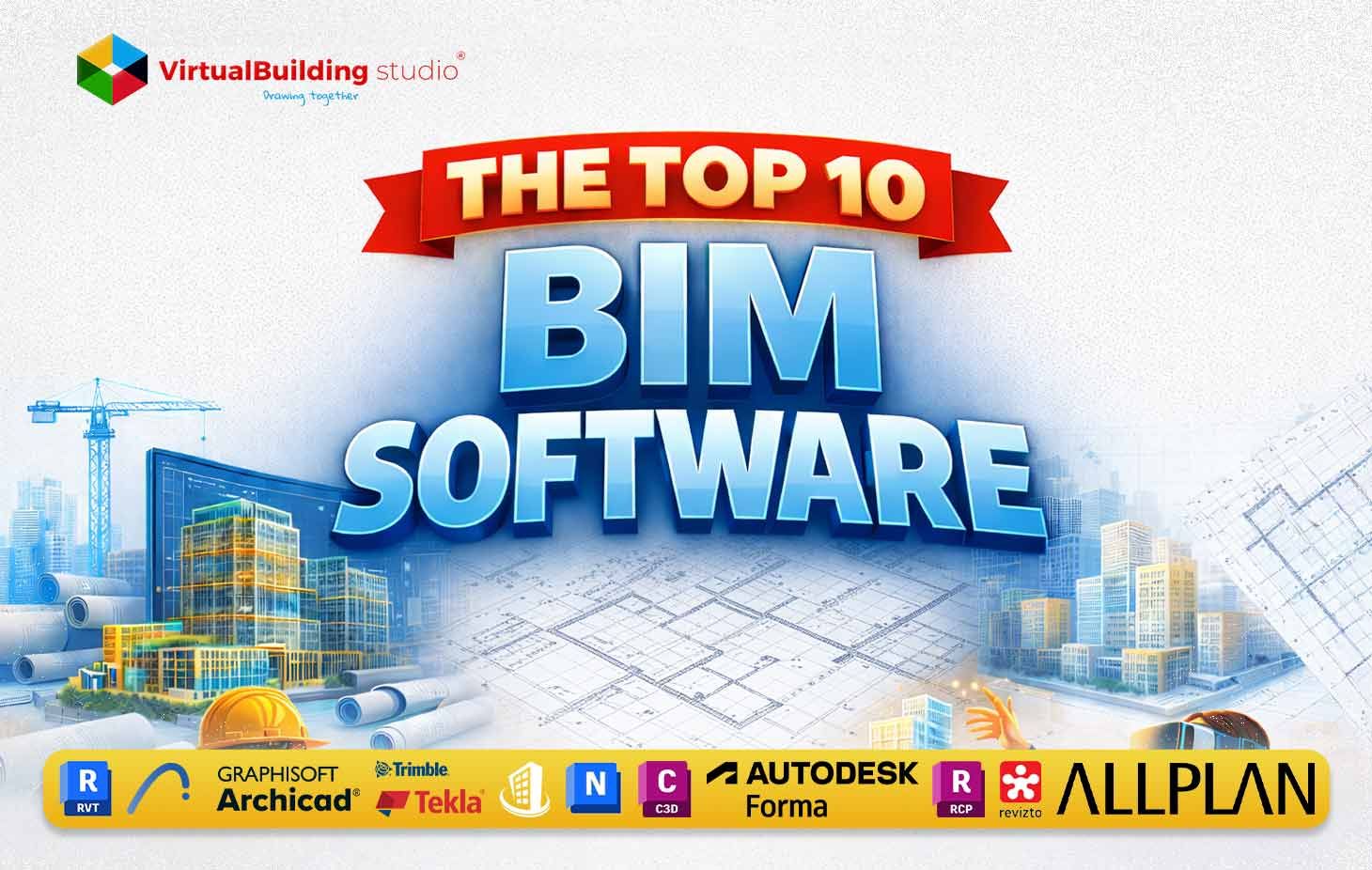
The Top 10 BIM Software Platforms for 2026
Autodesk Revit: Industry-Leading BIM Authoring Software
Revit software has undoubtedly become the first option for multi-discipline BIM in North America. It is the place where architectural concept turns into structural logic and MEP coordination—already on a single platform.
What It Does Best
- Parametric BIM for architecture, structure, and MEP
- Integrated clash detection and coordination
- Works natively with Autodesk Construction Cloud
In 2026, Revit’s improvements comprise AI-assisted design suggestions and reality capture integrations, thereby enabling quicker and more accurate iterations of the design.
Why It Matters
Revit’s ecosystem, when combined with tools such as Navisworks and the Autodesk Construction Cloud, creates a BIM platform that is well coordinated and is able to deal with real project delivery, not just modeling. Its huge user base secures the availability of a vast talent pool and training resources.
Best For: AEC companies that want a complete and multi-disciplinary BIM authoring solution.
Graphisoft Archicad: Design-Centric BIM Software for Architects
Archicad integrates architectural creativity with BIM intelligence, which is its strength. It really comes into its own at firms where design quality and early collaboration are the top priorities.
What It Does Best
- Intuitive design-first interface
- Strong OpenBIM (IFC) support
- Real-time collaboration via BIMcloud
In the European and Asia-Pacific markets, Archicad is often a preferred choice because of its low learning curve and design flexibility.
Best For: Architecture-focused firms and teams emphasizing OpenBIM workflows.
Trimble Tekla Structures: Structural BIM Excellence
Tekla is designed for heavy structural complexity. It gives models ready for fabrication that link design to the shop floor.
What It Does Best
- Detailed modeling of steel, concrete, and precast
- Drawings for fabrication are automated
- CNC integration
This tool connects design and fabrication thus reducing waste and improving the quality of construction especially in industrial and high-rise projects.
Best for: Structural engineering and dealing with firms focusing on heavy fabrication and precision.

Bentley OpenBuildings Designer: Enterprise Infrastructure BIM
For big infrastructure portfolios, Bentley’s suite takes care of huge amounts of data as well as various professional teams.
What It Does Best
- Deals with large airports, central stations, and hospitals
- Energy and performance analysis that is integrated
- Digitally twin ready
In spite of the huge capital investment, this platform is still the best choice in areas where co-ordination at the enterprise level and lifecycle data are the main features.
Best For: Infrastructure megaprojects and complex facilities.
Autodesk Navisworks: BIM Coordination & Clash Detection Hub
Navisworks is the program that is used for different model parts coordination, where merging and resolving different vendors’ data sets is needed.
What It Does Best
- Brings together models from various platforms
- Clashes detected automatically with detailed reporting
- 4D simulation
Virtual Building Studio makes use of Navisworks to make sure that the team in the field never encounters a surprise model problem on site. This carefulness leads to timely completion of the project and reduced risk.
Best For: Project controls and VDC teams.
Autodesk Civil 3D: Infrastructure BIM Modeling Software
Civil 3D is still the best option for site and infrastructure BIM among all others.
What It Does Best
- Corridor and alignment modeling
- Terrain and grading
- Utilities and drainage
The 2026 improvements will further integrate Civil 3D with cloud collaboration thus making handoffs with architects and contractors more efficient.
Best For: Teams in land development and civil engineering.
Autodesk Forma: Early-Stage Design & Planning
Autodesk Forma is the winner when considering conceptual design and feasibility analysis with cloud-native simplicity.
What It Does Best
- AI-guided massing and site investigation
- Environmental performance insights
- Browser-based real-time involvement
This platform offers to the leaders a design comparison that is data-driven at the early stage of projects thus, shortening the decision-making cycles and lessening the effort wasted.
Best For: Initial planning and client involvement.
Autodesk ReCap: Reality Capture & Scan to BIM
ReCap by Autodesk speeds up the procedure of capturing the as-built data by transforming the point clouds into usable models.
What It Does Best
- Scan data processing from LiDAR and photogrammetry
- BIM and real-world conditions linking
- AI-assisted geometry extraction (2026)
This process is seen as a time saver in the field and increases accuracy by firms that are working on renovation or retrofitting projects.
Best For: Scan to BIM processes.
Revizto: Integrated BIM Collaboration & Issue Tracking
Revizto is the solution to the problem, which is the coordination throughout the different fields, teams, and places involved, that has always been the reason for disaster in difficult projects.
What It Does Best
- Tracking all issues in a central place and directly related to BIM models
- Getting different teams to work together instantly through architecture, structure, and MEP
- Compatible with the models of Revit, Archicad, Navisworks, and IFC
- Accessible to both office and field teams through the cloud and desktop
Revizto is the tool that enables the project participants to communicate through a common medium rather than through separate emails, screenshots, and spreadsheets. Design comments, conflicts, and RFIs are all linked to the geometry, thereby decreasing miscommunication and improving decision-making time.
Best For: AEC firms supervising multi-disciplinary teams that require closer coordination and quicker issue resolution.
Allplan: Multidisciplinary BIM Software for European & Global Projects
Allplan is a powerful BIM platform that has been well received in Europe, mainly in the area of structural and infrastructure projects.
What It Does Best
- Architectural and structural BIM modeling are integrated
- Concrete structures have advanced reinforcement detailing
- There are strong IFC and OpenBIM workflows
- Complex, large-scale models are handled reliably
Allplan is particularly useful in situations where precision engineering, adherence to local standards, and international cooperation are pivotal. Its ability to detail structures helps minimise fabrication errors and enhance the quality of construction.
Best For: Firms operating in European or international markets that are responsible for the infrastructure, bridges, and structurally complicated buildings.
Building Your 3D BIM Authoring Software Ecosystem
In 2026, no single platform will be able to provide a solution for everything. The pioneers will formulate ecosystems that are in accordance with the different types of the projects.
| Purpose | BIM Software |
|---|---|
| Core Authoring | Revit, Archicad, Tekla |
| Coordination | Navisworks |
| Infrastructure | Civil 3D |
| Conceptual & Planning | Forma, SketchUp |
| Reality Capture | ReCap |
| Documentation | Bluebeam |
Best practices are:
- Using IFC and BCF standards for interoperability purposes
- Choosing cloud collaboration to support remote coordination
- Setting up precise BIM execution plans (BEP)
- Spending on training and governance
Future-Proofing Your Investment in Building Information Modeling (BIM) Software
The years 2026 and afterward will experience:
- AI-Enabled Automation: Producing designs, identifying clashes, and estimating costs.
- Digital Twin Integration: Connecting BIM with operations.
- Cloud-First Collaboration: Workflows in real-time through the browser.
- Sustainability Modeling: Carbon footprint, energy performance.
Those trends are platforms that move along according to their needs, rather than getting stuck in one place.
Conclusion
The selection of BIM Construction Software in the present time is not only a matter of modeling. It is related to building resilience, risk reduction, and project value unlocking. Revit is still the key for cross-discipline cooperation. Tekla and Civil 3D dominate the heavyweight niche areas.
Navisworks and Bluebeam guarantee coordination and documentation excellence. The new tools like Forma and ReCap are getting faster at aiding decisions and capturing real-world data.
The companies that will prosper in 2026 will not only take up BIM but also reshape their entire process around it.
So, analyze your BIM modeling software stack. Identify the loopholes. Consult with technology specialists and give your staff the necessary training. A solid BIM strategy is not a cost burden but rather an advantage in competition.
Is your BIM setup truly helping you deliver projects faster, with fewer risks and better margins?